
NIRS · Mitochondrial oxidative capacity

From a NIRS recording to a mitochondrial rate constant — in one workflow.

MCMITO turns repeated-cuff near-infrared spectroscopy recordings into reproducible measures of skeletal-muscle oxidative capacity.

See how it works
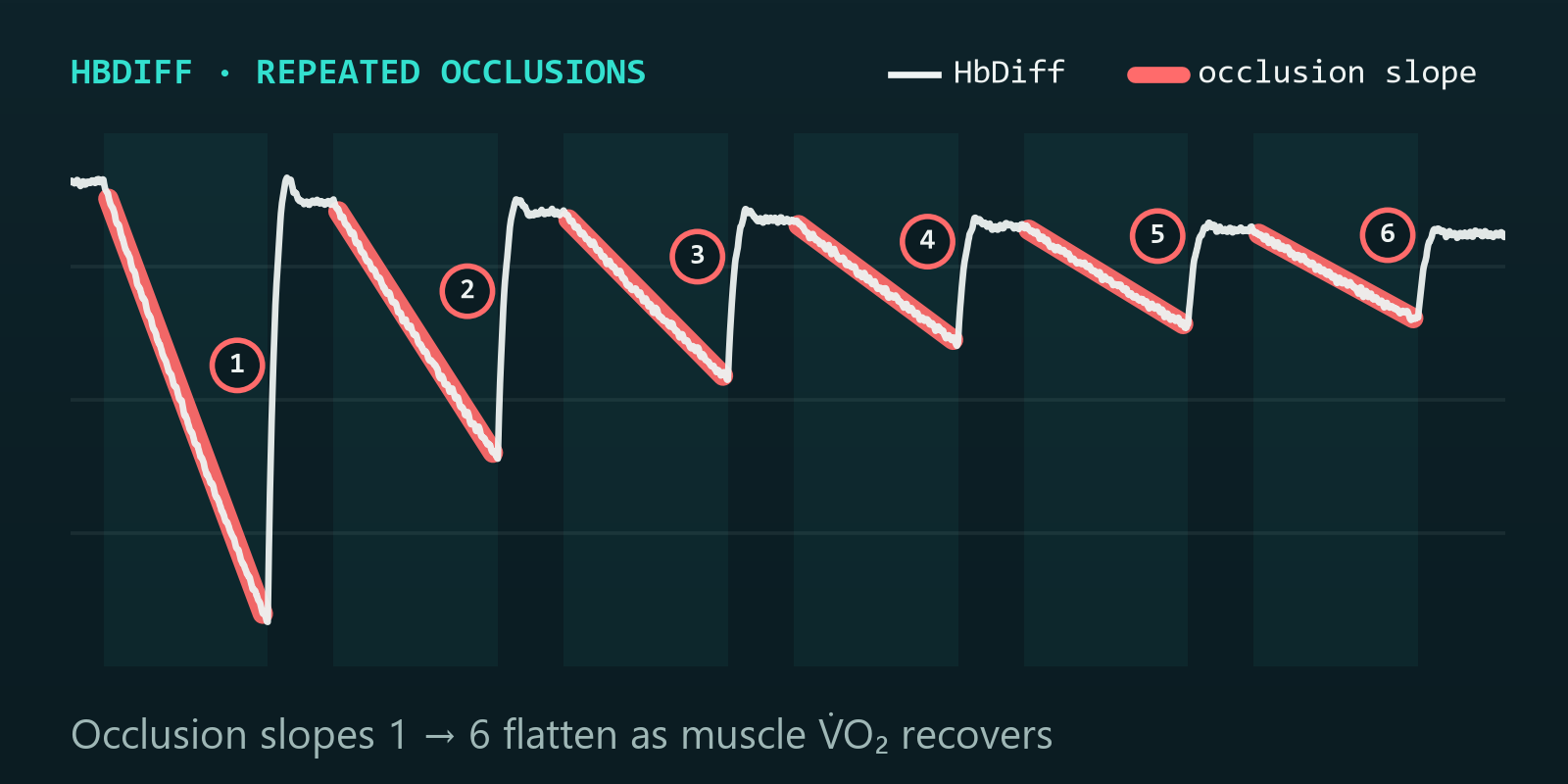
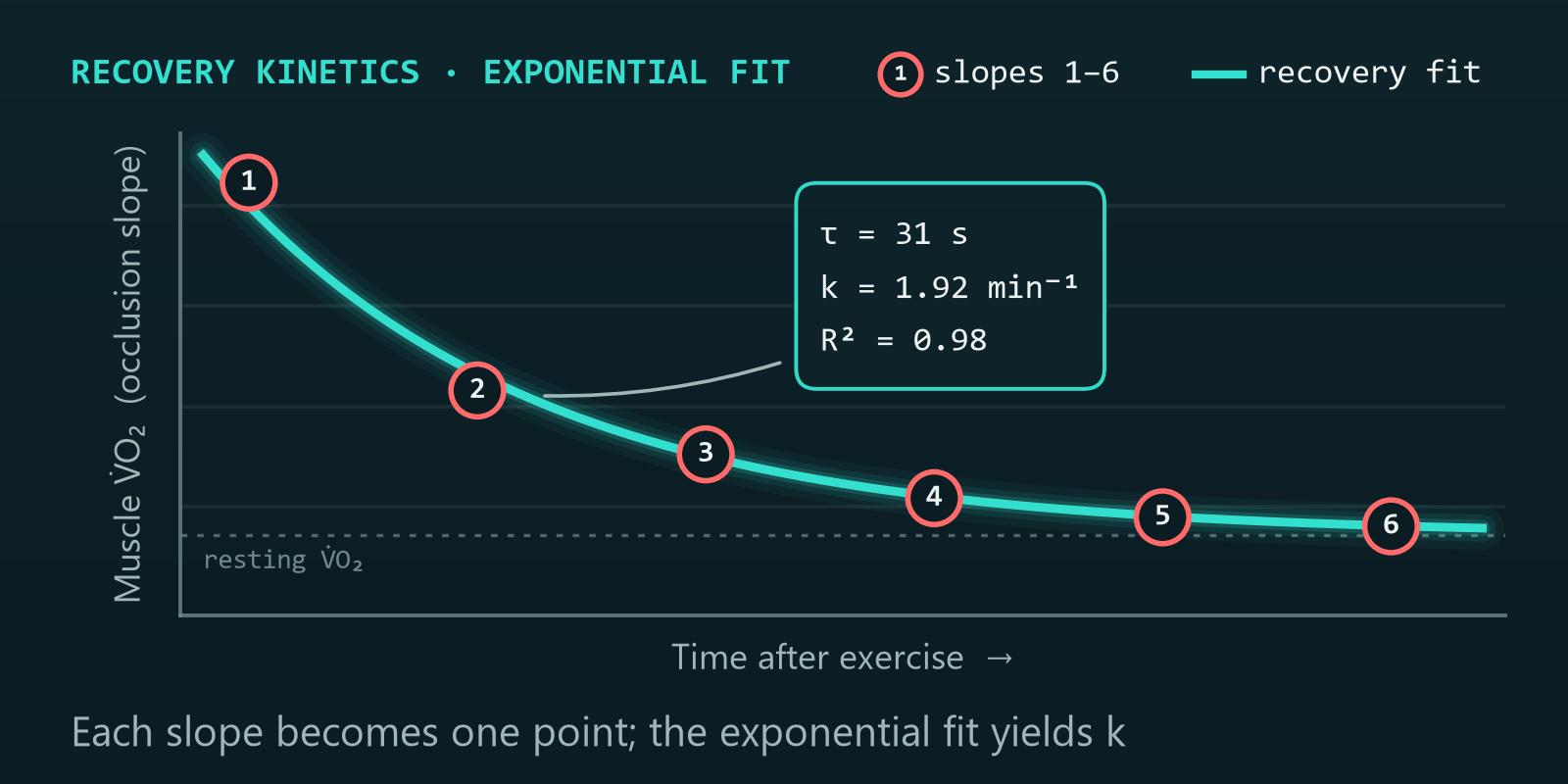
Raw HbDiff trace across six repeated arterial occlusions, the desaturation slope of each occlusion highlighted and numbered 1 to 6; the slopes flatten as muscle oxygen consumption recovers The six occlusion slopes plotted against time after exercise and fitted with a mono-exponential recovery curve, yielding the rate constant k
Capabilities

The complete oxidative-capacity workflow, done properly.

Everything from raw haemoglobin traces to a defensible rate constant — automated where it should be, transparent where it matters.

Automated occlusion detection

Consensus detection finds every cuff occlusion across each set, with confidence scoring you can audit, accept, or adjust.

Recovery-curve fitting

Fit the mono-exponential recovery of muscle O₂ consumption to a rate constant (k) and time constant (τ) — with standard errors and R² quality tiers.

Correction & calibration

Ryan blood-volume correction and physiological 0–100% calibration are built in, applied exactly as they are on your bench.

Transparent & reproducible

Every per-occlusion slope, exclusion, and fit is visible and exportable. Auditable results, not a black box.

Fast, interactive editing

Place, move, and remove markers with instant feedback on full-resolution traces — no lag between click and result.

Publication-ready exports

One click to a full Excel workbook and a formatted PDF report — saved to the folder you choose.

How it works

Five steps from recording to result.

A guided pipeline that mirrors the method as you run it in the lab.

01

Import

Drag in your NIRS recording. Map channels once; MCMITO remembers the layout.

02

Detect & mark

Auto-detect occlusions per set, or place and refine markers by hand.

03

Correct & calibrate

Apply blood-volume correction and physiological calibration to the signal.

04

Fit

Extract per-occlusion slopes and fit the recovery curve to k and τ.

05

Export

Save the Excel workbook and PDF report, and archive the full session.

Inside the platform

See it in action.

Real screenshots and screen recordings from the platform — from the imported trace to the fitted recovery curve and exercise-phase metrics.

Data Cleaning — auto-detect occlusions
One click of Auto-detect occlusions finds every cuff occlusion in each set and places the markers for you — each with a confidence score you can accept, shunt, or remove. Recorded live from the platform.
Data Cleaning — imported trace
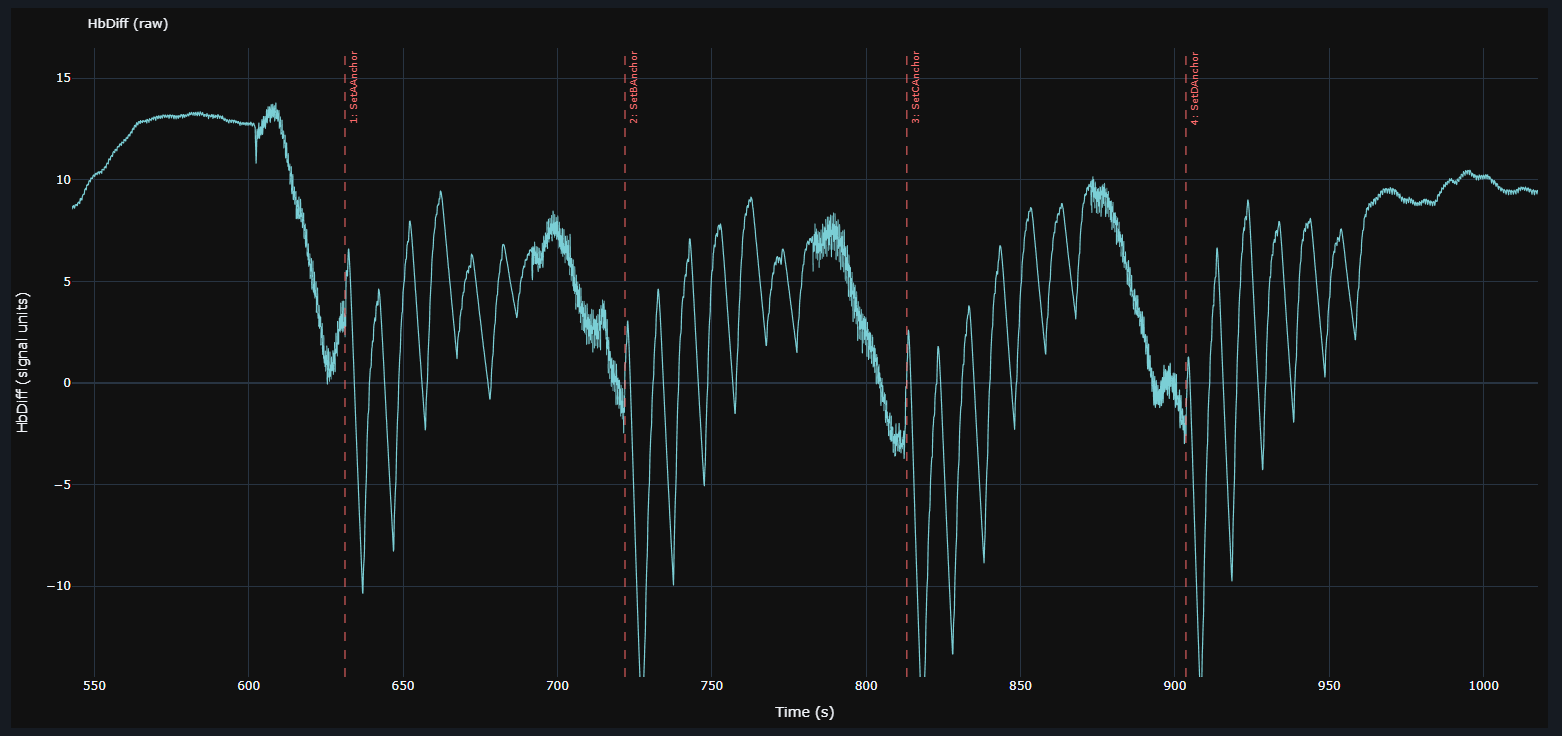
MCMITO Data Cleaning view: a raw HbDiff recording at full resolution with dashed set-anchor markers for four occlusion sets
The recording as imported: full-resolution raw HbDiff, with set anchors marking the start of each of the four occlusion sets.
Mitochondrial Oxidative Capacity — curve fitting
Cycling through the curve-fitting views: per-occlusion mV̇O₂ points fitted with the mono-exponential recovery, per set and combined.
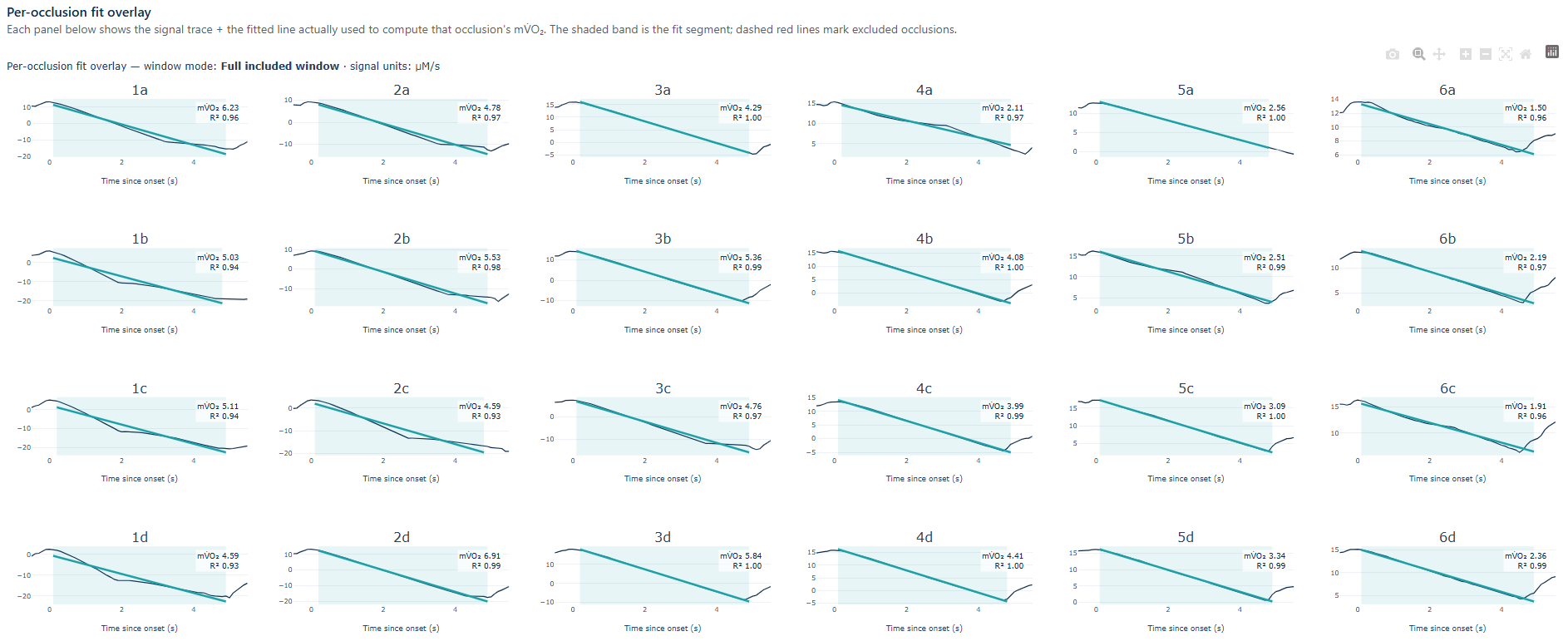
Per-occlusion fit overlay — mV̇O₂ and R²
Grid of every individual occlusion across four sets, each panel showing the signal, the fitted slope, its mV̇O₂ and R²
Every occlusion in every set, side by side — each showing the fitted line actually used, its mV̇O₂ and R². Exclusions are visible, not hidden.
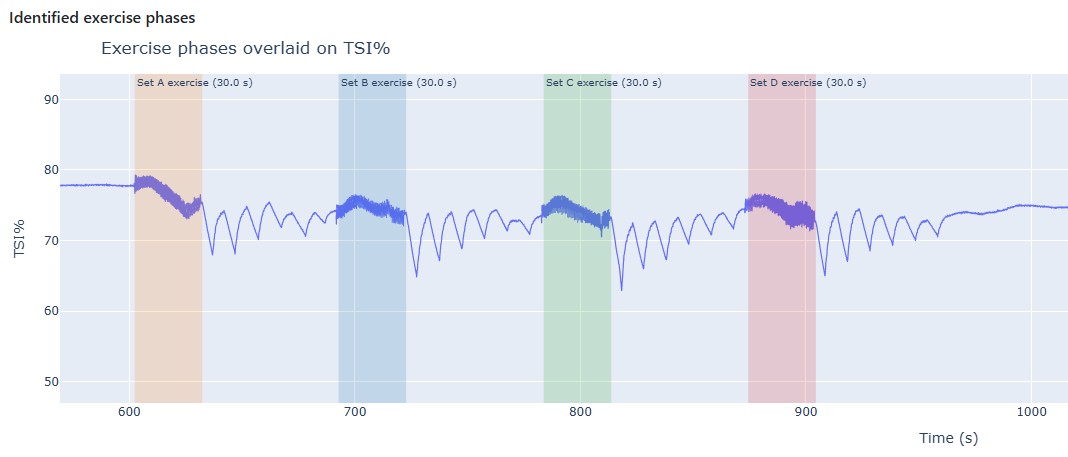
Exercise Stimulus — phase analysis
Exercise phases for four sets identified and shaded on the TSI% trace
Exercise-phase analysis: the exercise bout preceding each set is identified on TSI% and its key metrics extracted — the stimulus behind each recovery measurement.
Built on the method

Grounded in the published science.

MCMITO implements the established repeated-cuff NIRS method for muscle mitochondrial capacity, and has been validated against synthetic recordings with known kinetics — so you know the pipeline recovers the truth before it ever sees your data.

Ryan, Erickson, Brizendine, Young & McCully (2012)

Noninvasive evaluation of skeletal muscle mitochondrial capacity with near-infrared spectroscopy. J Appl Physiol 113:175–183.

Cite MCMITO

Using MCMITO in your research?

MCMITO is archived with a permanent DOI. Please cite the software, together with the underlying method it implements.

McManus, C. (2026). MCMITO: Near-infrared spectroscopy analysis of skeletal-muscle mitochondrial oxidative capacity (Version 1.1.0) [Computer software]. Zenodo. https://doi.org/10.5281/zenodo.22329660

Please also cite the method: Ryan MG, Erickson ML, Brizendine JT, Young HJ, McCully KK. Noninvasive evaluation of skeletal muscle mitochondrial capacity with near-infrared spectroscopy. J Appl Physiol. 2012;113(2):175–183.

Bring the whole analysis in-house.

A protected, licensed desktop application for your lab — installed and running in minutes, with your data never leaving your machine.

Terms of Use

Website terms · last updated 5 September 2026

These terms govern your use of this website. Your use of the MCMITO software itself is governed separately by the End-User Licence Agreement presented when you install it.

1. Use of this site

This website is provided for information about the MCMITO software. You may view and share its content for lawful, non-commercial, informational purposes. You must not misuse the site, attempt to disrupt it, or use it in any unlawful way.

2. No advice or warranty

The content on this site is provided in good faith and for general information only. It does not constitute professional, scientific, medical, or legal advice. To the maximum extent permitted by law, the site is provided “as is” without warranties of any kind, and we do not warrant that it will be accurate, complete, or uninterrupted.

3. Intellectual property

All content on this site — including text, graphics, logos, and the MCMITO name — is owned by or licensed to Chris McManus and is protected by intellectual-property laws. You may not reproduce or reuse it without permission, except as permitted by law.

4. The software

MCMITO is proprietary, licensed software. Access, installation, and use are subject to a separate licence and require a valid licence key. Nothing on this site grants you any right to use the software.

MCMITO is currently provided free of charge. It nevertheless remains licensed, not sold: your right to use it comes only from the End-User Licence Agreement, and we may change, suspend, or withdraw the free-of-charge offer at any time. Licences already issued continue for their stated term under that agreement.

5. Research use only — not a medical device

MCMITO is intended for research and educational use only. It is not a medical device and has not been assessed or approved by the Medicines and Healthcare products Regulatory Agency (MHRA) or any other regulatory authority. It must not be used for the diagnosis, prevention, monitoring, prediction, prognosis, treatment, or alleviation of any disease or condition, or for clinical decision-making. You are responsible for independently validating any results you rely on.

6. External links

This site may link to third-party sites we do not control. We are not responsible for their content or practices.

7. Liability

Nothing in these terms limits liability for death or personal injury caused by negligence, for fraud, or for any liability that cannot lawfully be excluded. Subject to that, to the maximum extent permitted by law we are not liable for any loss arising from your use of, or inability to use, this site.

8. Governing law

These terms are governed by the law of England and Wales, and the courts of England and Wales have exclusive jurisdiction.

9. Changes to these terms

We may update these terms from time to time. The current version is always the one published on this page, with the date of the last update shown above. Your continued use of the site after a change means you accept the updated terms.

10. Contact

Questions about these terms: cmcman@essex.ac.uk.

Privacy Policy

Last updated 5 September 2026

This policy explains how we handle personal data in connection with this website. It is written with the UK General Data Protection Regulation (UK GDPR) and the Data Protection Act 2018 in mind.

Who we are

The data controller for this website is Chris McManus (contact: cmcman@essex.ac.uk).

What we collect

This is a static informational website. We do not ask you to create an account or submit forms here. The site is hosted by Netlify, whose servers may automatically log standard technical information (such as IP address, browser type, and pages requested) for security and to operate the service; Netlify may process those logs outside the UK under its own privacy policy and standard data-protection safeguards. If you email us, we receive the information you choose to send.

To issue a licence key we also process the Machine ID shown on the MCMITO activation screen — a one-way hashed identifier derived from your computer’s hardware — together with the name, email address, and institution you give us.

How we use it

We use any information you send us solely to respond to your enquiry and to provide the software and licence keys you request. Our lawful bases under UK GDPR are our legitimate interests in operating this site and answering enquiries, and the performance of (or steps prior to) the licence agreement with you when we issue keys. We do not sell your data or use it for advertising.

The MCMITO software

The MCMITO application runs entirely on your own computer. It does not transmit your data, your participants’ data, or your results to us or to any third party. The one optional exception is software updates: if you use “Check for updates” in the app’s settings, it contacts GitHub (where MCMITO releases are published) to fetch release information and, if you choose, download the installer. This sends no analysis data or personal data beyond the standard connection details (such as IP address) that any web request involves, which GitHub handles under its own privacy policy. You remain the controller of any personal data you process with MCMITO and are responsible for your own compliance with data-protection law.

Cookies & analytics

This site does not set cookies and does not use analytics or advertising trackers. If analytics are added in future, this policy will be updated to describe them and, where required, ask for your consent.

Your rights

Under UK data-protection law you have rights to access, correct, or erase the personal data we hold about you, and to object to or restrict its processing. To exercise them, contact us at the address above. You may also complain to the Information Commissioner’s Office (ICO) at ico.org.uk.

Retention

We keep enquiry correspondence and licensing records only for as long as needed for those purposes and to meet legal obligations — as a guide, licensing records for the term of your licence plus 12 months, and general enquiries for up to 12 months after our last contact.

Coming soon

Hold your horses.

We’re putting the finishing touches to the final product. Ordering isn’t open just yet — but it’s coming very soon. In the meantime, drop us a line and we’ll let you know the moment it’s ready.

Keep me posted →